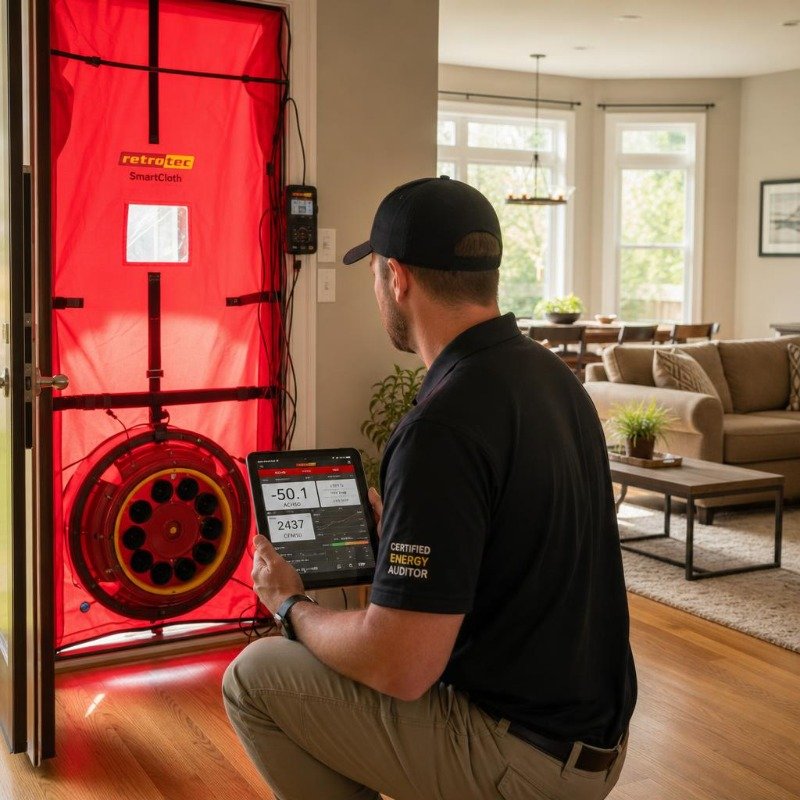
One of the most useful tests in a home energy audit is the blower door test. It measures leakage through the home's enclosure at a controlled test pressure. That is different from the amount of air entering under everyday weather conditions. But the goal isn't to seal a home completely shut, it's to stop accidental air leaks while making sure fresh air gets in the right way.
How a Blower Door Test Works
A blower door is a calibrated fan mounted in an exterior door frame with a flexible seal around it. We use it to depressurize your home, pulling air out until the inside is at a lower pressure than the outside. Outside air then rushes in through every crack, gap, and penetration in your building shell.
We measure how much air is flowing through the fan to maintain that pressure difference. The result tells us the overall tightness of your home. We can also use the test diagnostically, walking through the house with our hands or a smoke pencil to feel and see where air is entering.
Common places where air leaks in Michigan homes include the rim joist (where the floor framing meets the foundation), attic bypasses around wall cavities and plumbing, gaps around recessed lights, and penetrations for electrical and plumbing.
Why Tightening Your Home Matters
Every cubic foot of air that leaks into your home in winter is cold, dry outdoor air that your furnace has to heat. Every cubic foot that leaks in during summer is humid outdoor air your air conditioner has to cool and dehumidify. Appropriate sealing can reduce heating and cooling loads. Cost-effectiveness depends on the measured leakage, repair cost, Michigan weather, energy prices, and any ventilation changes needed; it is not always the highest-priority improvement.
A tighter home also stays more comfortable. Drafts may decrease and temperatures may become more consistent. Moisture still needs deliberate control; sealing without adequate ventilation can make some moisture and air-quality problems worse.
Fresh Air Is Still Essential
Every home needs adequate ventilation. Do not assume an older or visibly drafty Michigan home has enough fresh air: natural leakage varies with weather and does not reliably ventilate every room. A qualified professional should evaluate occupancy, pollutant and moisture sources, existing exhaust, measured leakage, and applicable standards before recommending a ventilation strategy.
Possible approaches include properly designed supply, exhaust, or balanced ventilation, sometimes using a heat or energy recovery ventilator (HRV or ERV). Selection depends on climate, humidity, building pressure, equipment compatibility, and required airflow. Do not add a furnace intake or choose an HRV or ERV solely because the home is in Michigan.
The key point is that when we tighten your home as part of an energy audit, we evaluate your ventilation at the same time. We're not just sealing things up and leaving, we're looking at the whole system.
Carbon Monoxide and Combustion Safety
Tightening a home also affects combustion appliances, gas furnaces, water heaters, and fireplaces. In a very tight home, these appliances can struggle to draw enough combustion air, or their exhaust can be pulled back into the living space. A qualified auditor should assess combustion safety before depressurization testing, follow the test safety procedure, and arrange appropriate combustion and ventilation checks after relevant sealing work. Do not perform a DIY blower-door test, disable safety devices, or block combustion-air openings. A passing check is not a permanent guarantee; CO alarms and equipment maintenance remain necessary.
This is one of the reasons a BPI-certified energy audit is more than just finding air leaks. It's a comprehensive safety and performance evaluation.
What the Results Mean for Your Home
After the test, ask for the test pressure, measured airflow or air-change result, comparison standard, and limitations. The result is not a direct measurement of normal-weather air exchange or a prediction of your utility-bill savings. Sealing work is prioritized by impact, the areas where the most air is moving get addressed first.
If you'd like to understand how your home is performing and where your energy dollars are going, a whole-home energy audit with blower door testing is the right starting point. Doty Service Network's BPI-certified auditors serve homeowners throughout Mid-Michigan. Call us to schedule.
Sources and scope
These references support the technical guidance, not a quote, a guaranteed outcome, or every product's features. Follow the equipment manufacturer's instructions and confirm applicable local requirements.
- U.S. Department of Energy, Consumer Guide to Air Sealing the Home (August 2021)
- U.S. Consumer Product Safety Commission, Winter Storm CO and Fire Safety (2026)