Your furnace and air conditioner do the work of heating and cooling your home, but it's the ductwork that delivers that conditioned air to every room. Leaks can divert air from its intended rooms or pull unwanted air into the system. Energy impact depends in part on whether that leakage crosses the home's conditioned enclosure; a basement is not automatically unconditioned space.
How Much Air Are You Losing?
ENERGY STAR's national Duct Sealing guidance estimates that a typical forced-air house loses about 20 to 30 percent of the air moving through ducts because of leaks, holes, and poorly connected ducts. This is an airflow estimate, not a measured result for Michigan homes, a claim that equipment works a third harder, or a 20-to-30-percent utility-bill savings promise. Actual effects depend on leakage location, supply and return balance, operating pressures, insulation, weather, and whether ducts are inside conditioned space.
Leaky ducts also pull unconditioned air in from those same unconditioned spaces: hot attic air in summer, cold crawl space air in winter. In homes with gas appliances, that air can carry combustion byproducts back into your living space.
What Duct Leakage Testing Involves
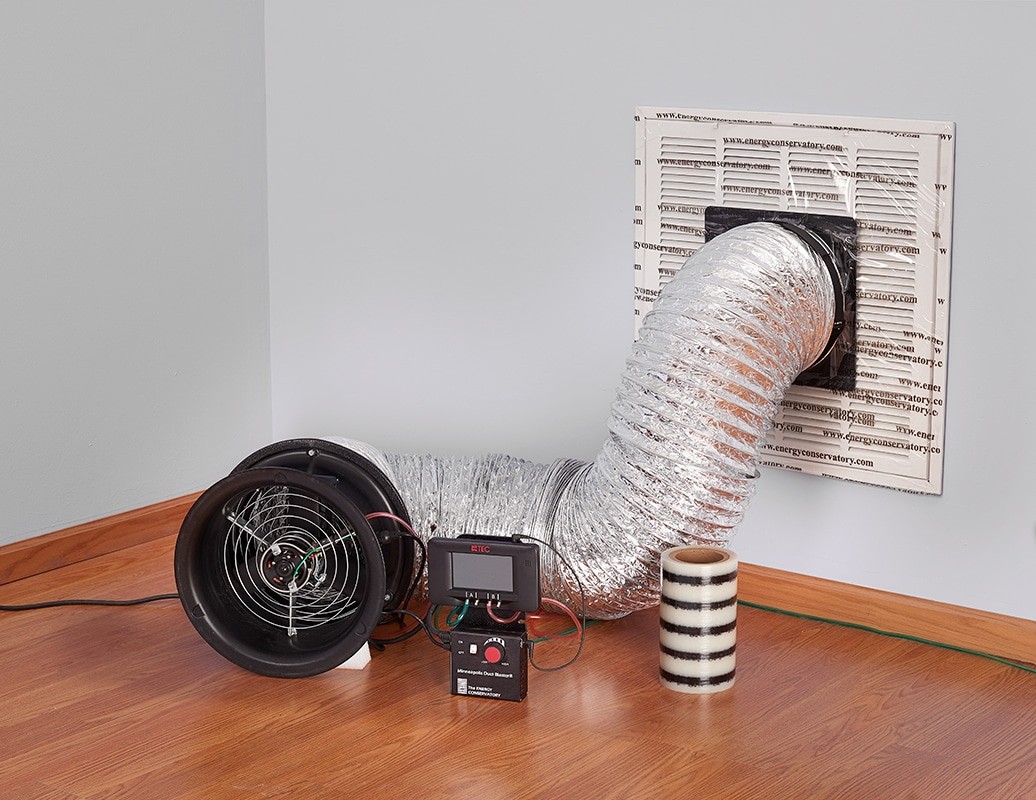
Duct leakage testing uses a calibrated fan, similar to a blower door, connected to your duct system. We pressurize the ducts and measure how much air escapes. The result measures leakage at the test pressure. The auditor must interpret it with duct location, operating conditions, and other findings; the test number alone does not establish annual energy loss or savings.
There are two types of duct leakage that matter. Total leakage measures everything escaping from the duct system. Leakage to outside the conditioned enclosure is particularly relevant to energy performance. Total leakage also matters for airflow and comfort. Definitions, test procedures, and qualifying thresholds vary by rebate program and must be checked against its current rules.
What Duct Sealing Involves
For accessible ducts in basements, crawl spaces, and mechanical rooms, we use mastic sealant, a flexible, long-lasting compound that adheres to duct surfaces and stays effective even as ducts expand and contract with temperature changes. Where tape is appropriate, use a duct-sealing product listed for that application and follow its instructions; ordinary foil tape is not automatically suitable. We never rely on cloth duct tape, which fails quickly.
For ducts in finished spaces or hard-to-reach attics, professional aerosol duct sealing may be an option after assessing the system's suitability. It works from the inside: we pressurize the duct system with an aerosol sealant that deposits on leaks from within, sealing gaps that would otherwise be impossible to reach.
After sealing, we re-test the system so you have a documented before-and-after comparison.
The Benefits Beyond Energy Savings
Appropriate sealing can improve air delivery and reduce unwanted air entry, but it does not guarantee lower bills, longer equipment life, or resolution of every comfort or air-quality problem. Sizing, airflow, insulation, filtration, ventilation, and moisture sources may need separate attention.
Safety Before and After Sealing
Have a qualified professional assess airflow, pressure balance, ventilation, and combustion safety before and after relevant duct work. Do not seal furnace flues, combustion-air openings, or safety devices. Leave concealed ducts, suspect asbestos-containing insulation, and work near fuel-burning appliances to qualified professionals.
Rebates and Incentives
Some Michigan utility programs may cover qualifying duct work, but eligibility, required tests, contractor approval, and preapproval rules vary and can change. Doty Service Network can walk you through what's available for your utility and situation.
If your home has rooms that never get comfortable, an HVAC system that runs constantly, or energy bills that seem out of proportion to how much you use, your ductwork is a good place to start. Call us to schedule a duct leakage test.
Sources and scope
These references support the technical guidance, not a quote, a guaranteed outcome, or every product's features. Follow the equipment manufacturer's instructions and confirm applicable local requirements.
- ENERGY STAR, Duct Sealing (national guidance; not a Michigan savings forecast)
- U.S. Department of Energy, Consumer Guide to Air Sealing the Home (August 2021)