If your home never seems to stay warm in winter, your cooling bills are out of control, or some rooms are always too hot or too cold, the problem usually isn't just one thing. It's the whole picture, how well your home holds heat, how efficiently your equipment runs, and where energy is silently escaping. A whole-home energy audit looks at all of it.
What Is a Whole-Home Energy Audit?
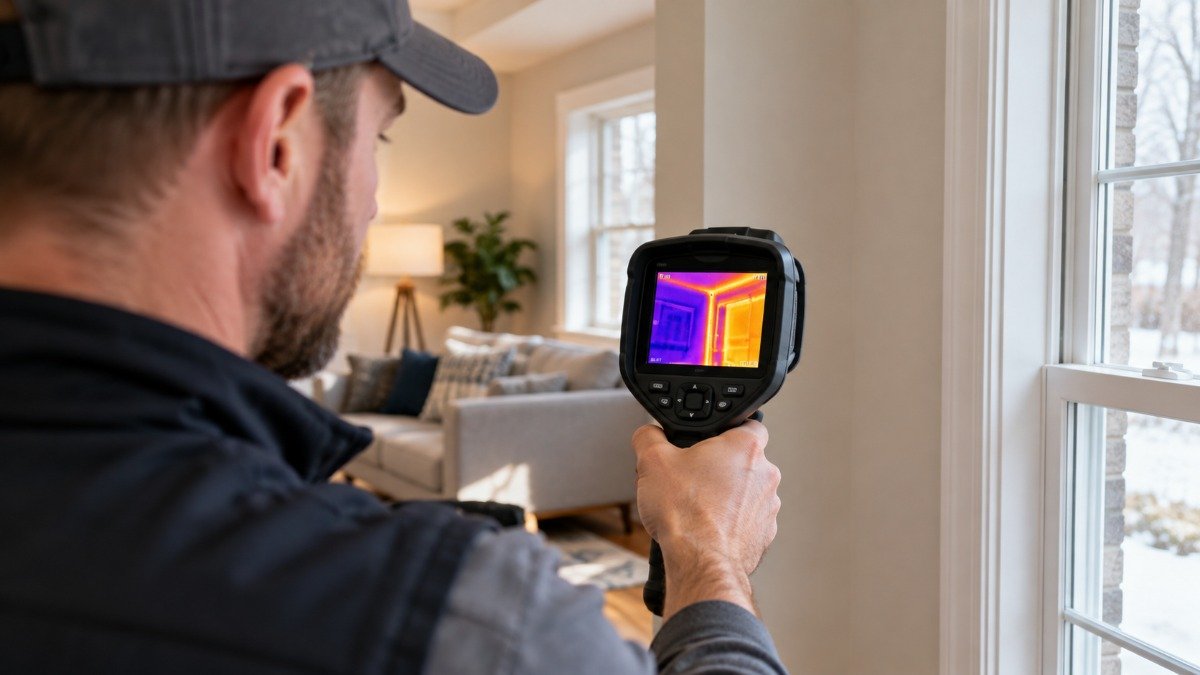
A whole-home energy audit is a comprehensive inspection of your home's energy performance. A BPI-certified energy auditor evaluates the building as a system, not just the furnace, not just the windows, but everything working together. The goal is to find where energy is being wasted, what's driving up your utility bills, and what improvements will give you the biggest return.
What We Look At
Insulation is one of the biggest factors in how well your home holds heat. We check insulation levels in the attic, walls, and crawl space or basement, and identify areas where it's missing, settled, or inadequate for Michigan's climate.
Air sealing goes hand-in-hand with insulation. Even a well-insulated home can lose significant heat through gaps around light fixtures, plumbing penetrations, attic hatches, and rim joists. We use a blower door test to measure the overall tightness of your home and identify the biggest leaks.
Your heating and cooling equipment gets evaluated for efficiency, proper sizing, and condition. Oversizing, poor maintenance, and inefficient equipment can increase energy use, but the dollar impact requires a home-specific comparison of operation, weather, and utility rates.
Ductwork carries conditioned air through your home. ENERGY STAR's national guidance estimates that typical forced-air homes lose about 20 to 30 percent of duct airflow through leaks, holes, and poorly connected ducts. That is not a measurement of your home or a utility-bill savings estimate. Heat transfer through poorly insulated ducts is a separate issue. We test leakage and assess duct location and insulation; ducts inside a conditioned Michigan basement can have a different energy impact from ducts in an unconditioned attic or crawl space.
Appliances and water heating contribute significantly to your energy use. We look at the age, efficiency, and condition of your water heater, refrigerator, and other major appliances.
Electrical service and lighting round out the picture. Lighting efficiency affects electricity use; the electrical panel's condition and load capacity are separate safety and capacity questions. A panel upgrade alone is not an energy-saving measure, and panel inspection or electrical work belongs with a licensed electrician.
What You Receive
After the audit, you receive a written report that prioritizes improvements by impact and cost-effectiveness. The report should distinguish measured findings from estimated savings, explain baseline and weather assumptions, and note uncertainty. Expected improvements are not guarantees of a particular bill reduction.
Why BPI Certification Matters
BPI (Building Performance Institute) certification means your auditor has been trained and tested in building science. Certification does not automatically establish eligibility for every rebate. Confirm the current program's approved contractors, audit requirements, income or equipment rules, and preapproval deadlines before authorizing work.
Safety and Scope
Before diagnostic depressurization or significant air sealing, the auditor should assess combustion appliances, exhaust paths, ventilation, and other hazards. Ventilation and combustion safety must also be evaluated after relevant sealing work. Do not run a DIY blower-door test, block combustion-air openings, or disturb suspect asbestos or other hazardous materials. An energy audit is not a substitute for a licensed electrical or gas-equipment inspection.
Getting Started
If you're ready to understand what your home is actually doing, and what it would take to make it perform better, call Doty Service Network to schedule a whole-home energy audit. We serve homeowners throughout Mid-Michigan from our offices in Lansing and Vassar.
Sources and scope
These references support the technical guidance, not a quote, a guaranteed outcome, or every product's features. Follow the equipment manufacturer's instructions and confirm applicable local requirements.
- U.S. Department of Energy, Guide to Home Heating and Cooling (legacy reference for AFUE and sizing concepts, not current equipment standards or prices)
- ENERGY STAR, Duct Sealing (national guidance; not a Michigan savings forecast)
- U.S. Department of Energy, Consumer Guide to Air Sealing the Home (August 2021)